
The remote sedimentary islands along Bangladesh’s Brahmaputra River present a challenge that conventional power infrastructure is ill-equipped to solve. Traditional grid connections prove impossible across seasonal floods and shifting river channels that define these “char” regions, leaving thousands without electricity. To address this problem, Summit Group launched a micro-grid project, and it has since earned international recognition, demonstrating how localized renewable energy can reach populations that national grids leave behind.
The Summit-Friendship Solar Village project was recognized by the Reuters Global Energy Transition Awards under “Projects of Impact” category in 2024. This 57.6 kilowatt scalable solar microgrid serves approximately 3,000 people in Char Kabilpur, Gaibandha district. It was selected from among 500 global entries for its concrete results in improving energy affordability and climate resilience.
“Summit wants to serve 100% of Bangladesh with infrastructures such as electricity and communication. Some ‘Char’ areas, which are outside the national grid, also deserve electricity,” said Muhammed Aziz Khan, founder of Summit Group.
Powering Remote Regions
The collaboration between Summit Group and international social purpose organization Friendship demonstrates how infrastructure companies can partner with NGOs to address remote area electrification. Its benefits reach 205 ultra-poor households, a local market with 26 shops, four primary schools, one Madrasa, and Friendship’s Legal Information Booth across areas currently outside Bangladesh’s national grid.
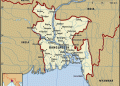
Char Kabilpur itself exemplifies broader geographic challenges facing rural electrification in Bangladesh. Located on a char, a remote sedimentary landmass formed within river systems, this community experiences seasonal flooding that makes traditional power line installation impractical. The newly installed solar microgrid functions as a hub for similar neighboring chars within the Jamuna River system, extending its impact beyond the immediate installation site.
The microgrid incorporates battery storage, irrigation pumps, and water systems alongside solar generation, creating an integrated infrastructure approach. This configuration addresses multiple community needs while providing reliable electricity despite seasonal weather patterns that affect the region.
The project’s success builds on Summit Group’s broader infrastructure experience across Bangladesh’s diverse geographic conditions. Founded in 1997 with Bangladesh’s first independent power plant, Summit established a foundation in power generation that now encompasses multiple technologies and delivery methods. Summit Power International operates as Bangladesh’s largest independent power producer, accounting for 18.05% of the country’s total private installed capacity and 7.36% of national installed capacity.
Community Impact
The solar village project addresses immediate infrastructure needs while creating economic opportunities for residents who previously relied on kerosene lamps and diesel generators. Extended operational hours enable longer business days for shops in the local market, while reliable lighting supports academic activities at the area’s four primary schools and one Madrasa.
Reduced reliance on traditional kerosene lamps eliminates toxic fumes and fire hazards in rural communities. Health benefits extend beyond basic electrification to address indoor air quality concerns that disproportionately affect remote populations without access to cleaner energy alternatives.
Training local residents to maintain the microgrid creates employment opportunities while ensuring long-term operational sustainability. Knowledge transfer to communities rather than requiring external maintenance teams builds local capacity for renewable energy systems.
“Anyone who has seen the mighty River Jamuna in spate will understand that mainline power grids are not really possible here,” said Runa Khan, founder of Friendship. “On the other hand, this solar grid will provide income-generating opportunities and livelihoods, as well as opportunities for children’s education, and of course that hope and dignity thrive. We want to thank Summit for its support.”
A Scalable Model for Remote Area Electrification
This project could serve as a potential model for similar geographic challenges across South Asia. The scalable nature of the 57.6 kilowatt system could be replicable in other char regions along Bangladesh’s river systems.
Summit Group operates within a broader context of infrastructure development across Bangladesh’s energy, telecommunications, and logistics sectors. The company’s telecommunications arm manages over 55,000 kilometers of fiber-optic network, while power operations include multiple generation technologies from combined cycle gas plants to renewable installations.
The micro-grid project represents a departure from Summit Group’s typical large-scale power plant development, demonstrating how established energy companies can adapt their capabilities to serve populations that traditional infrastructure approaches cannot reach. Flexibility in project scale and technology application is key in addressing persistent challenges in rural electrification efforts across developing countries like Bangladesh.
And the collaboration between Summit Group and Friendship demonstrates how private sector infrastructure capabilities can address development challenges through NGO partnerships. Friendship brings community engagement experience and local knowledge, while Summit Group provides technical expertise and financing capacity for renewable energy installations.
The partnership model differs from Summit Group’s typical approach to power generation, which centers on large-scale plants serving national grid requirements,including the roughly 590-megawatt Meghnaghat II power plant, which achieved commercial operation in April 2024, and multiple combined cycle facilities totaling over 2,000 megawatts of capacity. But the micro-grid project is a testament to the potential of smaller scale projects, particularly those that emphasize community input to overcome specific geographic and economic constraints.
Muhammed Aziz Khan noted the project’s role within Summit Group’s broader infrastructure commitment. “The award-winning Friendship NGO has done wonders,” he said. “It’s a privilege to provide solar energy to the 3,000 people of Char Kabilpur in association with Friendship.”
The micro-grid approach addresses a persistent gap in Bangladesh’s electrification progress. While the country has achieved near-universal electricity access, remote char areas remain outside conventional grid extension efforts due to seasonal flooding and shifting river channels. The project provides a replicable solution for similar geographic issues across Bangladesh’s extensive river system.
Integration with National Energy Goals
The micro-grid project also aligns with Bangladesh’s renewable energy targets while addressing rural development objectives. Bangladesh committed to deriving 40% of energy generation from clean sources by 2041, announced at COP26 climate conferences. While they are relatively small in scale, renewable installations like the Summit-Friendship project can contribute to this target while serving populations that large utility-scale projects cannot reach.
Summit Group’s involvement in micro-grid development represents diversification within its renewable energy portfolio. The company has announced plans for cross-border renewable energy projects importing solar,wind and hydropower from India, Bhutan, and Nepal, targeting utility-scale installations that serve national grid requirements.
At the same time, the Reuters award provides international validation for distributed renewable energy approaches in challenging geographic environments.
Rural electrification through micro-grids addresses energy access while creating local economic opportunities, education support, and health improvements. The Summit-Friendship collaboration has established a model that combines private sector technical capabilities with NGO community engagement, and the hope is that it is applicable across South Asia’s rural areas.